For most of my life, the bindi was simply something beautiful.
Growing up in the South African Indian community, I had worn bindis before, of course. There were the little stick-on ones that coordinated perfectly with an outfit, the glittering ones reserved for Diwali or a special occasion, the decorative dot that completed the look. But if you had asked me then what my bindi meant, I probably would have said: nothing in particular. It was aesthetic… Cultural… Festive!
And then something changed.
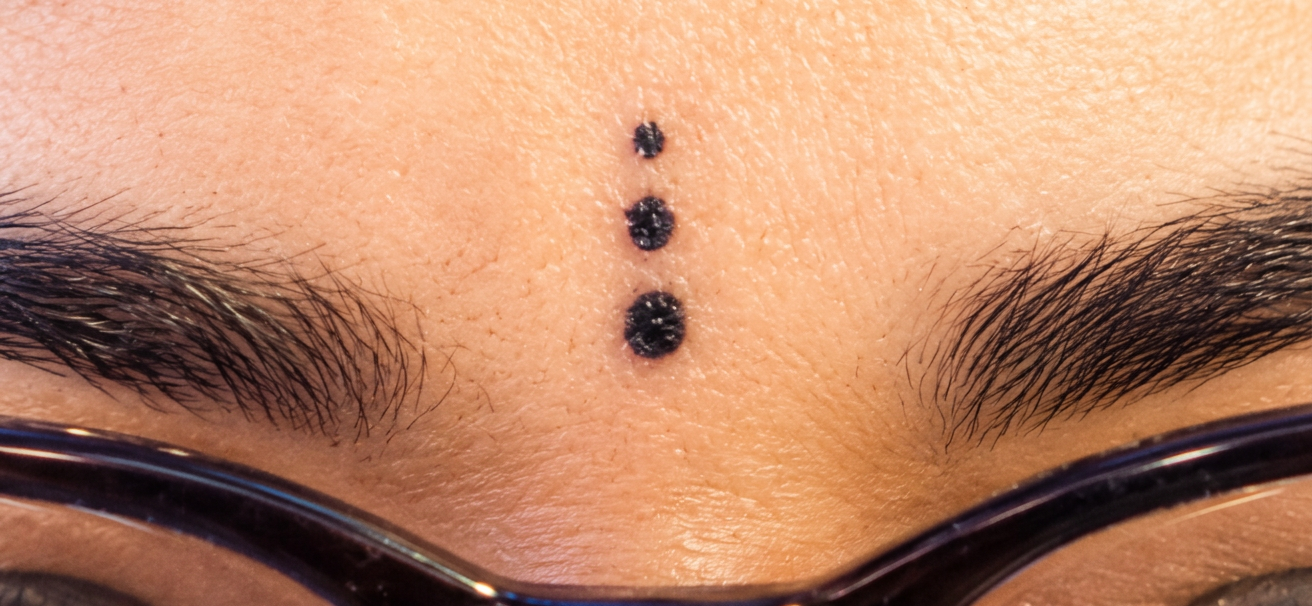
It was years later, during my yoga teacher training – an immersive month-and-a-half experience at an ashram in Bangalore – that I began to wear a bindi differently. Not deliberately, at first. I simply started placing three small dots on my forehead. The strange thing is that I don’t remember making a conscious decision to do this.
And even stranger: the dots weren’t identical. They seemed to naturally form a little progression: larger at the bottom, becoming smaller as they moved upward. At the time, I didn’t stop to ask myself why. It was just what my hand wanted to do.
Perhaps this is one of the quieter ways that sādhanā works. Something begins to shift inside us before the mind has caught up enough to explain it.
When a bindi becomes a ritual
After my training, the three dots stayed. What had begun almost unconsciously became part of my morning routine. I would put them on as naturally as I would brush my teeth or sit down to practise. I began wearing them every day, and usually throughout the day, unless they literally washed or rubbed away. It wasn’t something I had announced to myself as a spiritual practice. There was no moment when I thought, From today, I shall wear a bindi.
It simply became part of me.
A friend eventually noticed. She pointed out that I seemed to be wearing my bindi all the time now, not only for Diwali, special occasions or to complement an outfit. Her observation made me pause. I realised that somewhere along the way, I had fallen into a ritual without consciously creating one. And that, in itself, fascinated me.
Because the ritual had arrived before the explanation. And only then did I begin to wonder: what is it that we are really placing on the forehead when we make a sacred mark?
The tilak is more than decoration
In Hindu traditions, sacred forehead markings can carry meaning far beyond adornment. Their forms vary across sampradāyas, lineages and practices, and they can serve as visible reminders of devotion, spiritual orientation and the path one follows. Two familiar examples are the Tripundra and Urdhva-Pundra.
The Tripundra is associated with Shaiva traditions and is traditionally formed from three horizontal lines of vibhuti, sacred ash.
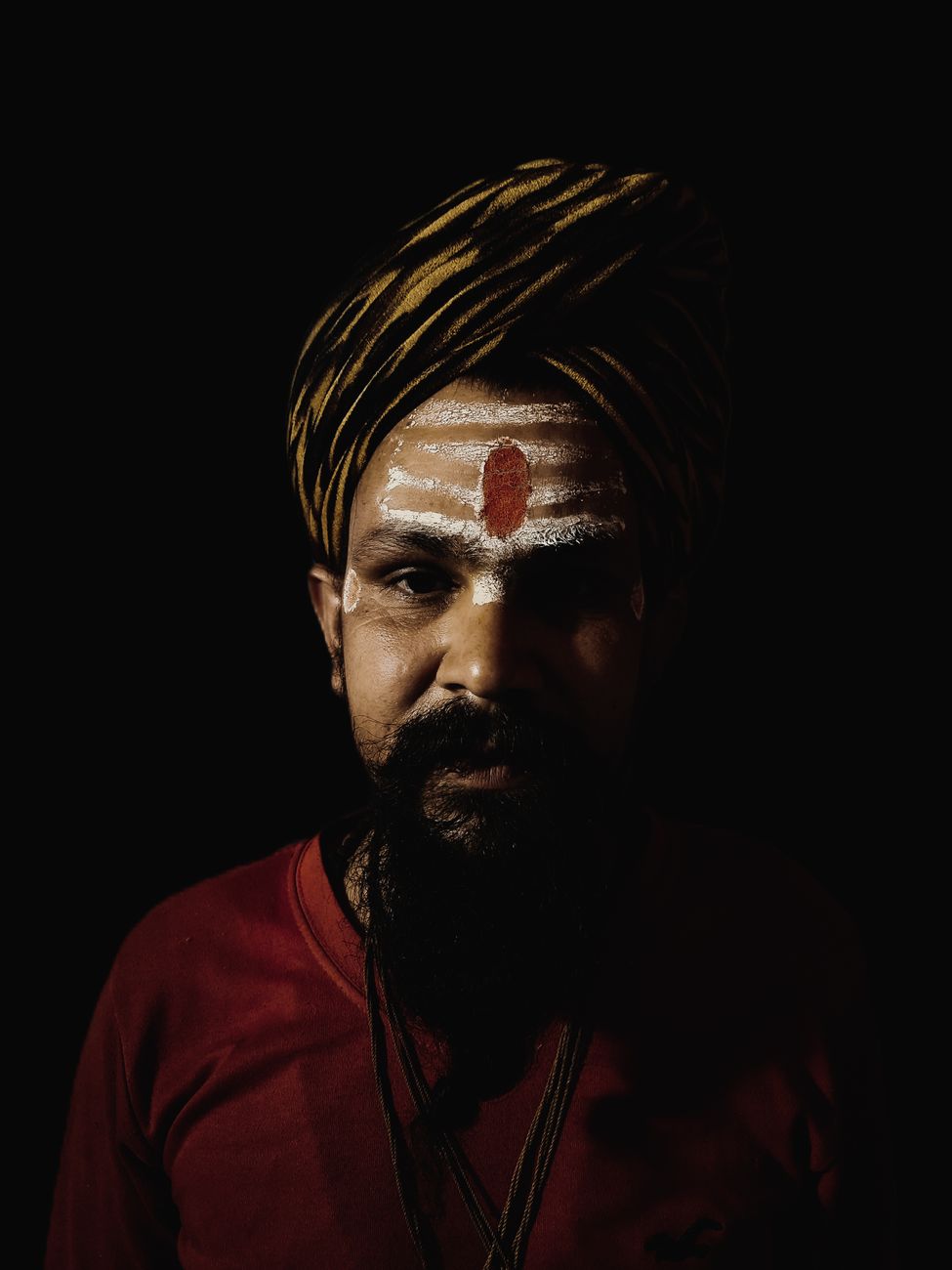
The symbolism of the ash can be contemplated as a reminder of impermanence: everything belonging to the material world – our bodies, possessions, identities and even the identities we construct around the ego – is subject to change and dissolution. The three lines therefore become more than something placed on the skin. They can serve as a reminder to loosen our attachment to what we mistake as permanent, to recognise the transient nature of worldly identification, and to turn our awareness toward that which is deeper than the changing personality.
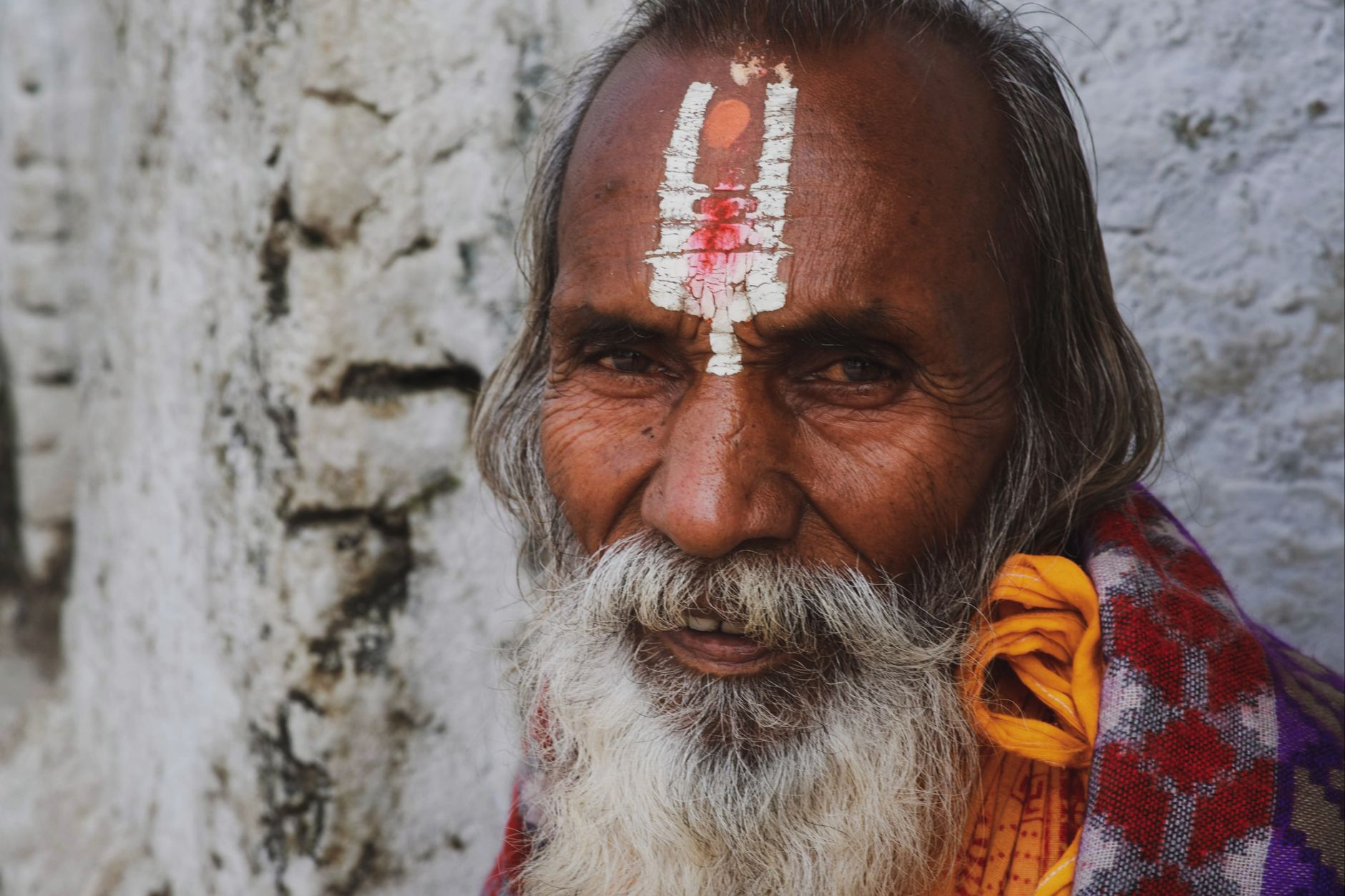
Then there is the UrdhvaPundra, the vertical marking associated with Vaishnava traditions.
Urdhva means “upward,” and the vertical orientation carries an entirely different visual movement: upward, toward the Divine. Traditionally made with substances such as sacred clay, the marking is associated with the feet of Vishnu, while the central element in many Vaishnava traditions is associated with Lakshmi.
There is something beautiful in the contrast.
One symbolism turns our attention toward release – the dissolution of ego and attachment. The other turns our attention toward aspiration – the soul rising toward the Divine. Release and rising. Letting go and reaching upward. Different traditions, different symbols, different theological frameworks—and yet both use the forehead as a place of remembrance.
So why three?
This is where I began to look differently at my own three dots.
The symbolism of three appears again and again throughout Hindu philosophy and spiritual traditions. The post that prompted me to think more deeply about the tilak spoke of three as a symbolic pattern of creation, preservation and dissolution, and also as body, mind and spirit. Yet these are not the only meanings attributed to three, nor is there one universal interpretation across Hindu traditions. But the recurrence itself is fascinating.
Three can suggest a movement, a relationship, a process.
And suddenly I found myself looking at my own three dots differently. I had never intended for them to represent anything. Yet their shape seemed to tell a story. The largest dot sits at the bottom. Above it is a smaller one, and above that, smaller still. Without consciously designing it, I had created a visual movement from gross to subtle. From the more tangible to the less tangible. From the outer to the inner. From the part of ourselves most easily identified with – the body, personality, roles, stories and ego – toward something increasingly subtle.
I began to wonder whether this could be contemplated as a movement of spiritual practice itself: not necessarily becoming something new, but gradually dissolving what obscures what has always been there.
Perhaps evolution is not always about adding. Perhaps sometimes it is about releasing.
The forehead as a place of remembrance
There is another layer that deepened this reflection for me.
In yogic traditions, the space between the eyebrows is associated with Ājñā chakra, often described in relation to inner vision, awareness and discernment. Different traditions explain the chakras in different ways, so I don’t see this as a single definition that has to be imposed on every practice.
But symbolically, the location of the bindi has always felt significant to me. We place it where the eyes cannot quite see themselves. A place associated with turning awareness inward. A place that can remind us to look beyond appearances – to observe rather than simply react, to become conscious of the stories we are carrying, and to remember that there may be more to our identity than the personality moving through the world.
And this brought me back to the sacred ash of the Tripundra. Ash reminds us: this too will pass. The body changes. Circumstances change. Relationships change. Possessions disappear. Even the version of ourselves that we are so certain we are today will eventually become a memory. What, then, remains?
The question itself can become a practice.
Bhūr, Bhuvaḥ, Svaḥ
There is another connection I have come to contemplate personally: the three vyāhṛtis –bhūr, bhuvaḥ, svaḥ – found in the Gāyatrī mantra.
I want to be careful here. I am not saying that my three dots are a traditional representation of the three vyāhṛtis. They aren’t something I consciously learned and then deliberately reproduced on my forehead. But as I reflected on why three appeared so naturally in my own practice, I found myself drawn to this threefold movement between levels of existence, often contemplated through the physical, intermediate and celestial realms, or through progressively subtler dimensions of experience.
Again, the symbolism isn’t something I need to pin down into a single definition. Perhaps that is part of the beauty.
The three dots became a little visual prompt for me:
Where am I placing my awareness?
What am I identifying with?
What am I moving toward?
The largest dot at the bottom can represent the most tangible layer of existence – the body, the personality, the world of form. The dots becoming progressively smaller can become a contemplation of subtlety: moving inward, upward, beyond the immediately visible.
Not escaping the physical world, but recognising that we are not limited to it.
The mark and the path
Perhaps this is why sacred markings have survived as such powerful elements of Hindu practice. They make an invisible intention visible. A person may look in the mirror and see a mark on their forehead, but the deeper purpose can be to remember something within themselves.
Remember your path.
Remember your devotion.
Remember what you are trying to realise.
Remember what you are trying to release.
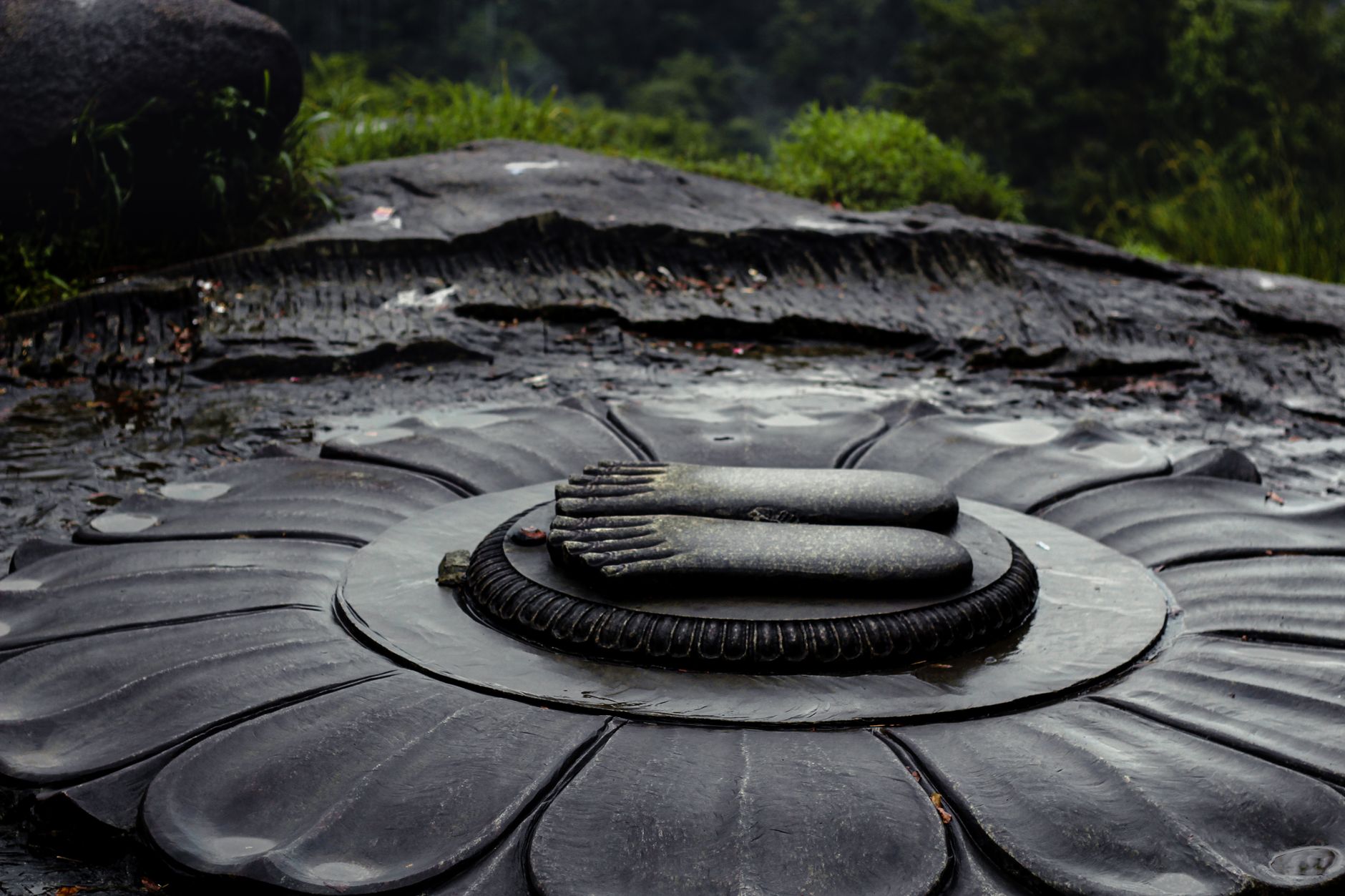
The tilak becomes a kind of embodied remembrance. And perhaps that is what happened to me, without my ever consciously deciding that it should. My three dots became a small daily act of remembrance. Not because I had been taught that my three dots had one particular prescribed meaning. They didn’t. Rather, meaning began to unfold through the practice itself.
I had started with something almost instinctive, and only afterwards discovered that the world of yoga and Hindu philosophy was filled with symbols that gave me language for what I had been intuitively exploring. That, to me, is one of the beautiful things about sādhanā.
Sometimes the body knows before the mind has the language. Sometimes the hand makes the gesture before the intellect understands the symbol. Sometimes we begin practising before we know what the practice is teaching us. And perhaps the journey is not always about finding the perfect explanation. Perhaps it is about becoming quiet enough to notice what is already unfolding.
I still place those three little dots on my forehead. The largest at the bottom. Then smaller. Then smallest. And every morning, without needing to declare exactly what they mean, I am reminded to move from the gross toward the subtle, from identification toward awareness, from holding on toward letting go. Perhaps I didn’t consciously choose them. Perhaps some deeper part of my practice did. And maybe that is one of the quiet gifts of sādhanā:
Sometimes the practice begins speaking to us in symbols before the mind has learned the language.

