Reading the Durga Saptashati during Navratri is a tradition many of us return to each year. Thirteen chapters, seven hundred verses, and a goddess riding into battle with a weapon in every hand. On the surface, it is a story of demons rising and demons falling, and that is a perfectly good way to meet it. But the longer I sit with it, the less it feels like a story about them. The battles begin to work like a mirror: the demons start to look familiar, not as monsters on a distant battlefield, but as the very things a sincere practitioner meets on the path: illusion, fear, attachment, repeated patterns, ego – and, if we are lucky, awakening.
Three movements of one journey
Traditionally, the Saptashati is divided into three charitras, or episodes. The first (Chapter 1) glorifies the Goddess as Mahakali, the second (Chapters 2 to 4) as Mahalakshmi, and the third (Chapters 5 to 13) as Mahasaraswati. These three forms are often read alongside the three gunas:
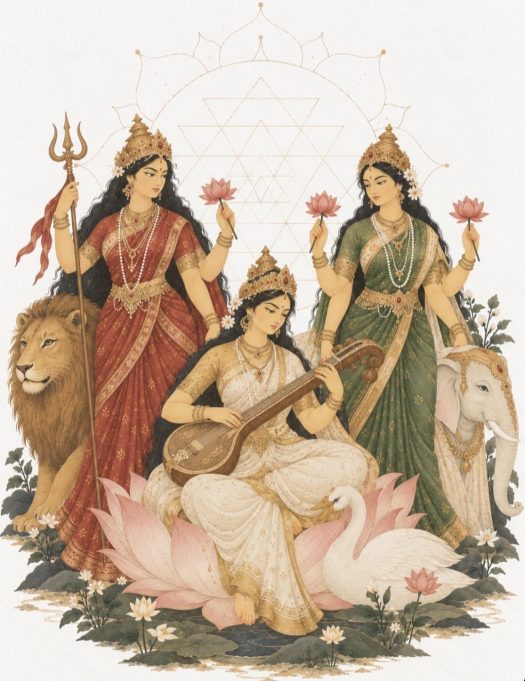
- Mahakali with tamas (inertia, sleep),
- Mahalakshmi with rajas (action, power)
- Mahasaraswati with sattva (knowledge, clarity).
The three are very unequal in length, but the movement is clear: wake up, gather and act, then see clearly.
Walk through the chapters with me and see if you recognise the terrain.
The question that starts it all
What I find easy to forget is that the Saptashati doesn’t begin with a war. It begins with two people who are quietly suffering: A king has lost his kingdom to enemies and been betrayed by his own ministers. A merchant has been driven out of his home by his wife and sons, who wanted his wealth.
Both find their way to the hermitage of a sage, and both confess the same strange thing: even now, they can’t stop worrying about the people who wronged them. They know better, and they still cling. The entire text is the sage’s answer to that human, very ordinary question: why can’t I let go? And his answer is Mahamaya – the great illusion, the power that can pull even the wise by the hair and deposit them in delusion. The battles that follow are not a change of subject. They are the answer, told as a story.
Illusion (Chapter 1)
The first charitra: the Goddess as Mahakali, tamas, the power that ends the long sleep.
The first demons, Madhu and Kaitabha, appear while Vishnu himself is asleep, held in the slumber of Mahamaya. Nothing can be fought until that sleep lifts. Only when the Goddess releases her hold does he wake and act.
This is tamas in its purest form: heaviness, inertia, the sleep of not seeing. I find it a quietly radical idea that the first thing the Saptashati asks of us is simply to wake up. So much of our struggle isn’t with the thing in front of us. It’s with the haze that stops us from seeing it clearly. And notice that the same Mahamaya who binds is also the one who frees. Illusion and liberation are not two different powers.
Gathering what is scattered (Chapters 2 to 4)
The second charitra: the Goddess as Mahalakshmi, rajas, power gathered and set in motion.
When the Goddess first takes form, it is because the gods have been defeated and scattered. Their strength has not disappeared, but it is spread across too many places to be useful. Then each deity lets their own radiance flow out, and those streams converge into a single blazing presence. Each god gives her a weapon of their own.
This is rajas, energy that moves and acts. There are seasons in a life when our courage is in one place, our discipline in another, and our faith somewhere we have forgotten to look. Shakti, in this telling, is not something that arrives from outside. It is what happens when what is scattered in us comes together.
Her first great opponent is Mahishasura, the buffalo demon, who never stays in one form. He is a buffalo, then a lion, then a man, then an elephant, then a buffalo again. Anyone who has dealt with a habit or a worry that keeps returning in a new costume, just when they thought they had solved it, will recognise him. What strikes me is that the Goddess is never rattled by his changes. She meets every form with the same steadiness until none are left.
And then comes a part of the journey that is easy to skip. The demon has fallen, and the gods, so recently scattered and afraid, could easily have stood tall and claimed the win. Instead, the first thing they do is bow. They sing a hymn of praise, recognising where the strength truly came from, and the Goddess promises to remove the troubles of anyone who remembers her in difficulty.
On the path, a victory is a delicate moment. Something shifts, a pattern loosens, a hard season ends, and the quiet temptation is to turn it into a story about me. The Saptashati places gratitude right here, before the next battle, as if to say: do not let the victory become another ego. Rajas, left unchecked, loves to claim the credit.
Fear (Chapters 5 to 7)
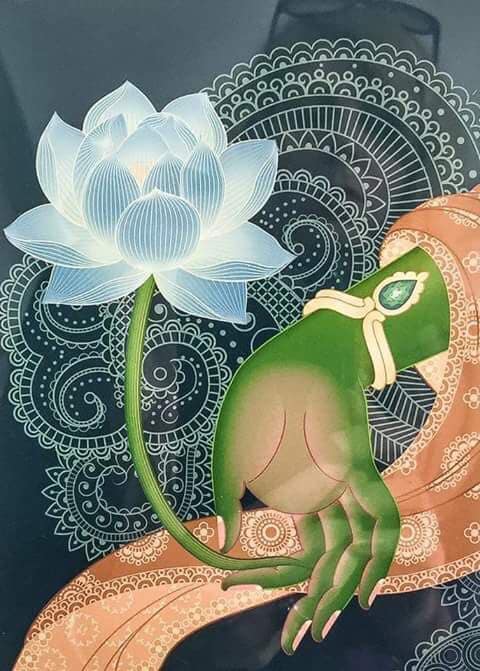
The third charitra begins: the Goddess as Mahasaraswati, sattva, the power of knowledge and clarity.
With Chapter 5 begins the third and longest charitra, and it makes sense to me that this is where the battles turn inward. This chapter is, for me, a hinge in the whole text.
The gods sing the great hymn that returns again and again in this tradition, praising the Goddess as the one who dwells in all beings, as awareness, as intelligence, as sleep and hunger, as strength and forbearance, as shame and peace, as faith and memory and compassion. She is not only the warrior on the battlefield. She is already here, in every shade of what it is to be alive.
Up to now we have met her as a power that arrives. In this chapter, we are shown that she was never away. I think it matters that this comes before the fear does, because it tells us where steadiness lives when the smoke rolls in.
Then Shumbha’s envoy arrives with a demand: his master wants the Goddess for himself. She answers that she has made a vow, to belong only to the one who can defeat her. Ego will try to possess Shakti, and it will fail. In answer, Shumbha sends Dhumralochana, “the smoky-eyed one”, to drag her away, and she reduces him to ashes with a single sound.
I read this as fear, because smoke is exactly how fear behaves. It clouds the vision and makes everything look larger and closer than it really is. A single clear sound, a moment of steadiness, and it is gone. This is my own symbolic reading, but notice what follows: Chanda and Munda come next, and the fight intensifies. The Goddess’s anger darkens her face, and from her brow springs Kali, who strikes them down. Sometimes we meet one fear, feel a moment of victory, and then find a deeper one waiting behind it. The path asks us to keep going.
Patterns that multiply (Chapter 8)
Raktabija shows us patterns that multiply.
He comes with a boon: every drop of his blood that touches the ground becomes another Raktabija, as powerful as the first. So the more the Goddess wounds him, the more demons fill the field. Fighting harder only makes the army grow. What I notice is the detail that matters most: the demon replicates only when the drop hits the ground. Not when he is wounded, but when what has been released lands and takes hold.
That feels so true of our thoughts. A worry arises, an old story about ourselves, a replay of something said years ago. A single thought is just a drop. But if we let it land, if we feed it, follow it and add to it, it becomes ten thoughts, then a hundred, and soon the whole field is crowded. Overthinking, fear and anger rarely overwhelm us in one blow. They multiply a drop at a time.
Look at how the battle turns. Kali, who sprang from the Goddess’s brow earlier, does not out-fight the army. She stands at the source and drinks each drop before it reaches the earth, so that nothing is left to multiply.
I find this a gentle, practical teaching for the sadhaka. We can’t stop a thought from arising, but we can learn to catch it before it grabs hold: to notice it, to name it, to watch it without feeding it. A thought that is seen early has no ground to land on. And when nothing takes root, the pattern that once seemed endless quietly runs out. This is sattva at work: the clarity to see a thought for what it is.
Attachment and ego (Chapters 9 and 10)
The last two demons are brothers. Nishumbha falls first, and he stands, in a symbolic reading, for attachment: the clinging, the wanting to possess. Shumbha, the elder, falls last, and he is ego, the voice that insists on being the owner of everything.
In the final battle, Shumbha sneers that the Goddess is not really fighting alone, that she depends on the strength of others. Her reply is one of my favourite moments in the whole text. She says, in essence, that there is only one of her in this world, and that all of these other goddesses are simply her own powers. Then they dissolve back into her.
The ego sees many, and it counts, compares and competes. Shakti is one. It makes sense to me that the ego falls last. It is the one that holds all the others together.
Awakening (Chapters 11 to 13)
When it is over, the gods once more bow and sing, echoing the first hymn. And the Goddess, who has just destroyed, promises to return whenever she is needed, as protector, as restorer. Destruction, here, has been in service of space.
Then the story circles back to the king and the merchant, who worship the Goddess with devotion. She appears and offers each a boon. The king asks for his kingdom back. The merchant, who has the very same wound, asks instead for the knowledge that will release him from attachment. She gives each what they truly seek. Even the Goddess, it seems, meets the seeker according to the seeker’s longing.
It feels fitting to me that this boon of liberating knowledge comes within the Mahasaraswati charitra. The journey that began in sleep ends in seeing.
What stays with me
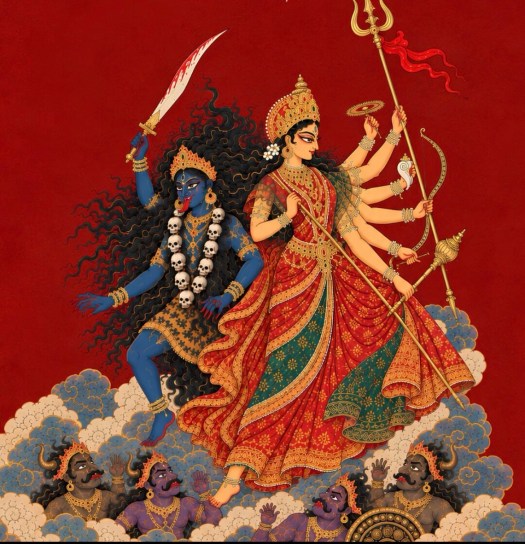
Every demon falls. Illusion lifts, fear loses its grip, attachment loosens, patterns dissolve, and ego bows. But with every battle, a stronger form of Shakti is revealed. The Goddess we meet at the end is not the same one we met at the start, and neither are we.
Maybe this is the real Navratri lesson. The Saptashati is not only an ancient story about ancient battles. It is a quiet reminder of our own Shakti, the power that was never outside us to begin with.
Mahakali, Mahalakshmi and Mahasaraswati are not only goddesses to be worshipped, but movements to be recognised within ourselves: waking, gathering, seeing.
This Navratri, as you read or listen, you might ask yourself: Which demon am I facing right now? Am I trying to meet it with more force, or with something quieter?
And what do I need to gather before I begin?
Jai Mata Di. 🌺

